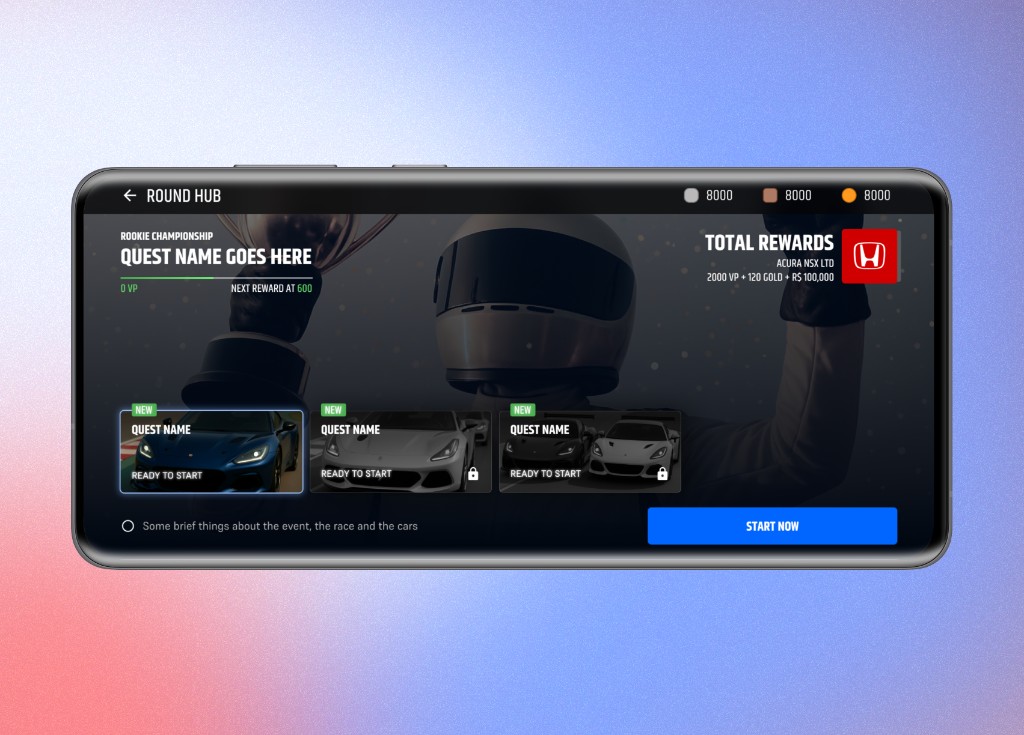
Rookie Championship
Real Racing 3 onboarding redesign — teach the game through play, not popups.
2024 · Shipped
+8%
Early retention (D7)
+4%
Daily active users
New players in Real Racing 3 finished the driving tutorial and were dropped straight into a decade of accumulated game systems — currency, car ownership, maintenance, events — with no idea where to find any of it.
Context
Real Racing 3 is a historic title with years of stacked content: currencies to earn and spend, cars to buy and service, events to enter. The existing FTUE ended the moment the driving tutorial did. It taught players how to drive a car in the game, but never how to play the game — where to buy a car, how to spend in-game currency, how to maintain a vehicle, or what any of the surrounding systems were for. Players were handed the keys to a system they didn't know existed.
That mattered because early habits are what determine whether a player sticks around. If players never learn to engage with the core economy — earning and spending currency, servicing cars — they churn before the game has a chance to hook them.
Constraints
Team was lean and cross-functional: me as the sole product/experience designer, one game designer, an art team, three game devs, and a game director — all of whom I worked closely with to keep the journey technically buildable and consistent with the rest of the game's UX.
Process
Progressive disclosure over front-loading. Rather than teaching every system up front, the new flow reveals game systems in the order a player actually needs them — starting with picking a racing category, then moving through event selection, round hubs, and rewards, layering in currency and car maintenance as those systems become relevant.
Designing for habit formation. A core goal was getting players to form the habit of sinking currency into car upgrades and maintenance early, since that loop is central to long-term engagement. The onboarding was structured around getting players to do this at least once, not just see it explained.
Working around engine limitations. Because the engine couldn't support some standard FTUE patterns, I had to identify an alternate approach rather than force a pattern the tech couldn't deliver. That meant designing the onboarding sequence around what the engine could actually render and sequence, rather than starting from a conventional playbook.
Fixing issues beyond the feature's edges. While designing Rookie Championship, I proactively flagged and fixed general UX patterns elsewhere in the game that would have caused friction for new players specifically — treating the onboarding project as a lens on the broader new-player experience, not just the screens inside this one flow.
Solution
The shipped flow moves a new player from category selection, through their first event and round hub — where quest progress, VP earned, and upcoming rewards are always visible — into currency spend and car maintenance, all without a single blocking tutorial screen.


Reflection
Beyond the onboarding flow itself, this project reinforced how much value there was in treating new-player friction as a systemic problem rather than a single feature's scope — several of the fixes that mattered most were general UX issues I found while designing this flow, not the flow's own screens. It also meant learning to design around engine constraints rather than trying to design past them, which shaped the final solution as much as any usability finding did.